|
Cumulia Illustrator Rendering Engine v2.1.0
A Rendering engine for industrial CAD/CAE model and optimized for greatest performance
|

|
|
Cumulia Illustrator Rendering Engine v2.1.0
A Rendering engine for industrial CAD/CAE model and optimized for greatest performance
|
|
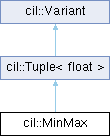
The MinMax class inherits from Tuple, specilizing the template parameters to float for element type. More...
#include <minmax.h>
Public Member Functions | |
| MinMax () | |
| MinMax (float min, float max) | |
| Constructs a MinMax object which holds two value (min, max), and initializes the min value as the lowest numeric limit and the max value as the maximum numeric limit. | |
| MinMax (const MinMax &other) | |
| const float & | operator[] (int index) const |
| Provides read-only access to the element at a specific index(position) within the MinMax object. | |
| float & | operator[] (int index) |
| Provides read-write access to the element at a specific index(position) within the MinMax object. | |
| MinMax & | operator+= (const MinMax &other) |
| Expands the current MinMax to emcompass the minimum and maximum value of the other MinMax. | |
| MinMax & | operator+= (float value) |
| Expands the current MinMax to emcompass the given value. | |
| void | set (float min, float max) |
| Sets the min and max value of this MinMax object. | |
| float | min () const |
| Gets the min value. | |
| void | setMin (float min) |
| Sets the min value. | |
| float | max () const |
| Gets the max value. | |
| void | setMax (float max) |
| Sets the max value. | |
| bool | isValid () const |
| Check if the MinMax is valid, which means that the minimum value should be less than or equal to the maximum value. | |
| float | center () const |
| Gets the mean value of the minimum and maximum values. | |
| float | length () const |
| Gets the extent of this MinMax. | |
| bool | inRange (float value) const |
| Check if a value is in the range of the MinMax. | |
| void | unset () |
 Public Member Functions inherited from cil::Tuple< float > Public Member Functions inherited from cil::Tuple< float > | |
| Tuple (int size) | |
| Constructs a Tuple object with a specified number of elements, and initialize all elements to 0. | |
| virtual | ~Tuple () |
| int | size () const |
| Gets the number of elements of the Tuple. | |
| float * | data () |
| Gets the data array of the Tuple. | |
| const float * | data () const |
| Gets the data array of the Tuple, and the data could not be modified upon which this function is called. | |
| void | setData (const float *data) |
| Sets the data array of the Variant. | |
| Tuple< float > & | operator= (const Tuple &other) |
| Copys the data of another Tuple to the one on which the operator is invoked. | |
| bool | operator== (const Tuple &other) const |
| Compares the Tuple with another one, and returns true if they are equal, otherwise returns false. | |
| bool | operator!= (const Tuple &other) const |
| Compares the Tuple with another one, and returns false if they are equal, otherwise returns true. | |
| Public Member Functions inherited from cil::Variant | |
| Variant () | |
| virtual | ~Variant () |
| const std::string & | type () const |
Additional Inherited Members | |
| Protected Attributes inherited from cil::Tuple< float > | |
| float * | m_data |
| The data array of the Tuple. | |
| int | m_size |
| The number of elements that the data array of the Tuple holds. | |
| Protected Attributes inherited from cil::Variant | |
| std::string | m_type |
The MinMax class inherits from Tuple, specilizing the template parameters to float for element type.
| cil::MinMax::MinMax | ( | ) |
| cil::MinMax::MinMax | ( | float | min, |
| float | max ) |
Constructs a MinMax object which holds two value (min, max), and initializes the min value as the lowest numeric limit and the max value as the maximum numeric limit.
| cil::MinMax::MinMax | ( | const MinMax & | other | ) |
| float cil::MinMax::center | ( | ) | const |
Gets the mean value of the minimum and maximum values.
| bool cil::MinMax::inRange | ( | float | value | ) | const |
Check if a value is in the range of the MinMax.
| bool cil::MinMax::isValid | ( | ) | const |
Check if the MinMax is valid, which means that the minimum value should be less than or equal to the maximum value.
| float cil::MinMax::length | ( | ) | const |
Gets the extent of this MinMax.
| float cil::MinMax::max | ( | ) | const |
Gets the max value.
| float cil::MinMax::min | ( | ) | const |
Gets the min value.
| MinMax & cil::MinMax::operator+= | ( | float | value | ) |
Expands the current MinMax to emcompass the given value.
| float & cil::MinMax::operator[] | ( | int | index | ) |
Provides read-write access to the element at a specific index(position) within the MinMax object.
| const float & cil::MinMax::operator[] | ( | int | index | ) | const |
Provides read-only access to the element at a specific index(position) within the MinMax object.
| void cil::MinMax::set | ( | float | min, |
| float | max ) |
Sets the min and max value of this MinMax object.
| void cil::MinMax::setMax | ( | float | max | ) |
Sets the max value.
| void cil::MinMax::setMin | ( | float | min | ) |
Sets the min value.
| void cil::MinMax::unset | ( | ) |
 1.11.0